

A case study on WorldWise Global Schools Guiding Principle 3, Prioritising Human Rights
“It’s really nice to learn about (human rights) and see how the world can be better and how we can contribute to it, but also what has already been done and how far we have come.“
Yutika, 5th year student
“When you have that taster of the information in school it makes you curious…when you have that kind of curiosity it makes you want to learn more about it and makes you want to solve more things about it.“
Khadijat, 5th year student
Context
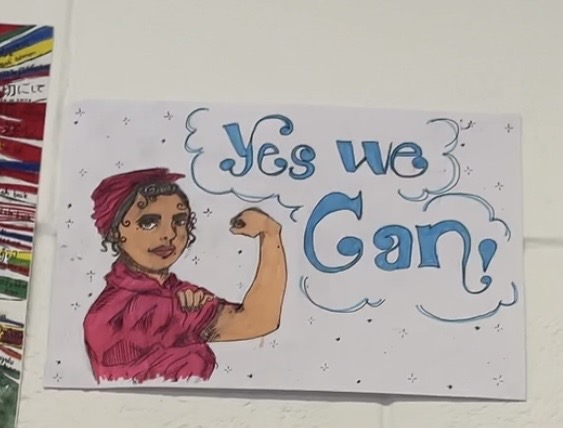
St Joseph’s College, Lucan, is a Catholic school for girls with a diverse student population. As a CEIST school, St Joseph’s is guided by the values of respect and responsibility with a focus on empathy and inclusivity. There is also a passion for prioritising human rights. This is most evident among a group of students from 3rd, 4th and 5th year who, along with their Religion teacher Megan Plummer, come together in room G57 or what they proudly call the ‘Women’s Empowerment Room’.
“It makes it much easier to talk about the difficult issues when you’re in a room surrounded by people who will listen, who will be honest, who will talk to you and you feel comfortable with.“
Sienna, Transition Year Student


The sense of empathy among the students in the Women’s Empowerment Room is palpable. Students consistently highlight how real-life stories and case studies have deepened their understanding of human rights issues; how hearing lived experiences personalises and “makes it more real” (Kathy, 5th year) allowing learners to emotionally connect and empathise with people suffering human rights abuses. This learning environment not only provided a warm welcoming space for this case study, it also contextualises Global Citizenship Education (GCE) characterised by hope and feelings of empowerment in St Joseph’s College.
Finding GCE Connections Across the Curriculum
Michelle Dunne, the WWGS lead contact, teaches Chemistry and Environmental and Social Studies and started out her GCE journey with a school garden project and a focus on the Sustainable Development Goals (SDGs). Michelle became aware of Megan Plummer’s Religion classes and her work on human rights, women’s rights and human trafficking. Collaboratively, Michelle and Megan sought out GCE connections across the school, taking note of what other staff members were doing, sharing ideas and building capacity along the way. Michelle referred to this process of building GCE connections as a ‘multiplier effect’, driven by student interest and knowledge and increasingly supported by class teachers.
Students and their teachers at St Joseph’s find spaces to explore human rights in History, English, Politics and Society, Religion, CSPE, Climate Action and Sustainable Development, Transition Year projects, the Senior Book Club, Concern Debating, and more. The table below represents some of the GCE curricular connections already in action in St Joseph’s. Download the pdf file to access the links here.

Michelle and Megan intend to use the WWGS Global Passport to present the ‘bigger picture’ to the entire staff, to demonstrate the GCE connections across the curriculum and to use it to support a whole-school approach to GCE.
Human Rights Inspiring Hope
The students in the Women’s Empowerment Group were aware of their own human rights lens on the world around them. As 5th year student Lauren put it, “once you start seeing it (human rights issues), you can’t stop, you can’t not see it”. These students recognise that human rights issues are not limited to far away places; they recognise the local to global connections. Lauren highlighted that human rights abuses are not confined to “the TV or radio. It happens here, it happens to people the same age as me, just like me and it’s not just some far off country, it’s us, it’s here, it’s now”.
The WWGS Guiding Principles are evident in the knowledge, understanding and empathy these girls express: in particular Unlearning and Reconstructing, Prioritising Human Rights and Making Local to Global Links. The students are cognisant of the gravity of human rights abuses, and while they describe it as ‘daunting’ and ‘scary’ they also express the need to be ‘brave’, to create safe spaces, to speak up, to advocate. What was most profound was their expressions of hope. In addition to human rights inspiring hope, the students expressed feelings of empowerment.
“I think when you become more aware, I think it does help you become a bit more hopeful. In the sense that you do something and you feel like oh I’ve actually done something, I’m actually making a difference and there’s active hope in that. I’m actually contributing, I’m actually helping people, I’m helping spread awareness and it’s as simple as that.”
Lauren, 5th year
“Since we started talking about these human rights issues, I am a lot more open to speaking up in class, like if there’s a debate or something I am now more likely to speak up and argue a side.”
Vanessa, 5th year
Exploring Human Trafficking as a Human Rights Issue
Religion teacher Megan is passionate about Human Trafficking as a human rights issue. Her interest was sparked during the 2020 lockdown as she engaged with a survivor’s testimony online. Megan did her own research into the topic, found and created resources and connected with relevant organisations to support her and her students to explore the issue.
Human Trafficking Awareness Month
For the last 3 years Megan has organised human trafficking awareness month in St Joseph’s College. A key aspect in January 2025 was the sculpture Let the Oppressed Go Free, by Timothy Schmalz. This emotive sculpture, on loan from the Irish organisation Act to Prevent Trafficking (APT), was displayed in the school’s central area and during assembly so that all classes could view and engage with it. APT has a number of resources for secondary schools on their website, including the CAPTIVES Programme, an educational resource highlighting Human Trafficking in Ireland.

A group of Transition Year students took the initiative to create a video about the sculpture and its meaning. They wrote a script, presented, recorded and edited the video themselves. The video was shown to all staff and students and the intention is to present it at future Human Trafficking Awareness Months in the school. It was also played at the TY Graduation, where the student film creators received a Global Citizenship Education award from the school for their dedication to human trafficking awareness.
International Human Trafficking and Social Justice Conference (IHTSJC)
As a result of Megan connecting with Dr. Celia Williamson, founder of the IHTSJC, students Anna (TY) and Sarah (5th year) will participate in the 2026 conference by way of a prerecorded opening and closing video statement. The 2–3-minute videos were professionally recorded and edited by a videographer who works with TY students in St Joseph’s.
Fundraising: bringing awareness as well as cakes!
St Joseph’s has hosted a number of student-led fundraising initiatives aimed at raising awareness of human trafficking and women’s rights. These events included a bake sale and book sale in aid of Cork Against Human Trafficking, an information desk and fundraiser for AkiDwA (network of migrant women living in Ireland), dragon boat racing for Breast Cancer Ireland, selling wrist bands for Women’s Aid and more.
For information on these organisations and other GCE facilitators, see the WWGS Directory of GCE Facilitators on our website.


Students from the Women’s Empowerment Group pointed out that fundraising offers an opportunity to ‘educate others (on human rights) in a light-hearted way’, to express empathy and to stand in solidarity with those affected by these issues. To ensure critical GCE, fundraising was scaffolded by the teaching and learning carried out in classrooms (see table above) as well as through the events of human trafficking awareness month (for more ideas on scaffolding GCE events and activities see the WWGS Guide to Scaffolding). One ongoing scaffolding activity is a workshop on female genital mutilation, led and delivered by 6th year student Emani, supported by her teacher Megan and facilitated by other class teachers. Emani is rolling out this peer learning project across the whole school, acting as a role model to others, making learning more relatable and encouraging dialogue on a sensitive human rights issue.
Advice for Exploring Human Rights Issues
Human trafficking, and the associated human rights issues, engages educators and learners in emotive and controversial topics. Megan emphasised the importance of open dialogue, active listening and the creation of safe spaces:
“I am a firm believer that you shouldn’t avoid difficult conversations, because it’s so important, and you never know who might need to hear it that day, or even in 10 years’ time… So number one don’t avoid it and number two create an open space where students can have a conversation, where they feel valued”.
Megan’s advice is to start off with what students already know, break down stereotypes and link human rights to values. She stresses the significance of explaining to students why this is a human rights issue, why it’s important to you as an individual, to us as a society and to them as global citizens in the here and now.
For more on Creating Safe and Inclusive Classrooms see pages 5 and 6 in the WWGS Activities Resource, available for download in English and as Gaeilge on our website.
*Megan Plummer is available discuss this topic in more depth, share resources and provide more detail on the school events. If you wish to get in touch with Megan email WWGS at info@worldwiseschools.ie
More case studies…


A Whole-center Approach to GCE in West Wicklow Youthreach
A case study on a WorldWise Global Schools’ Special Passport Holder